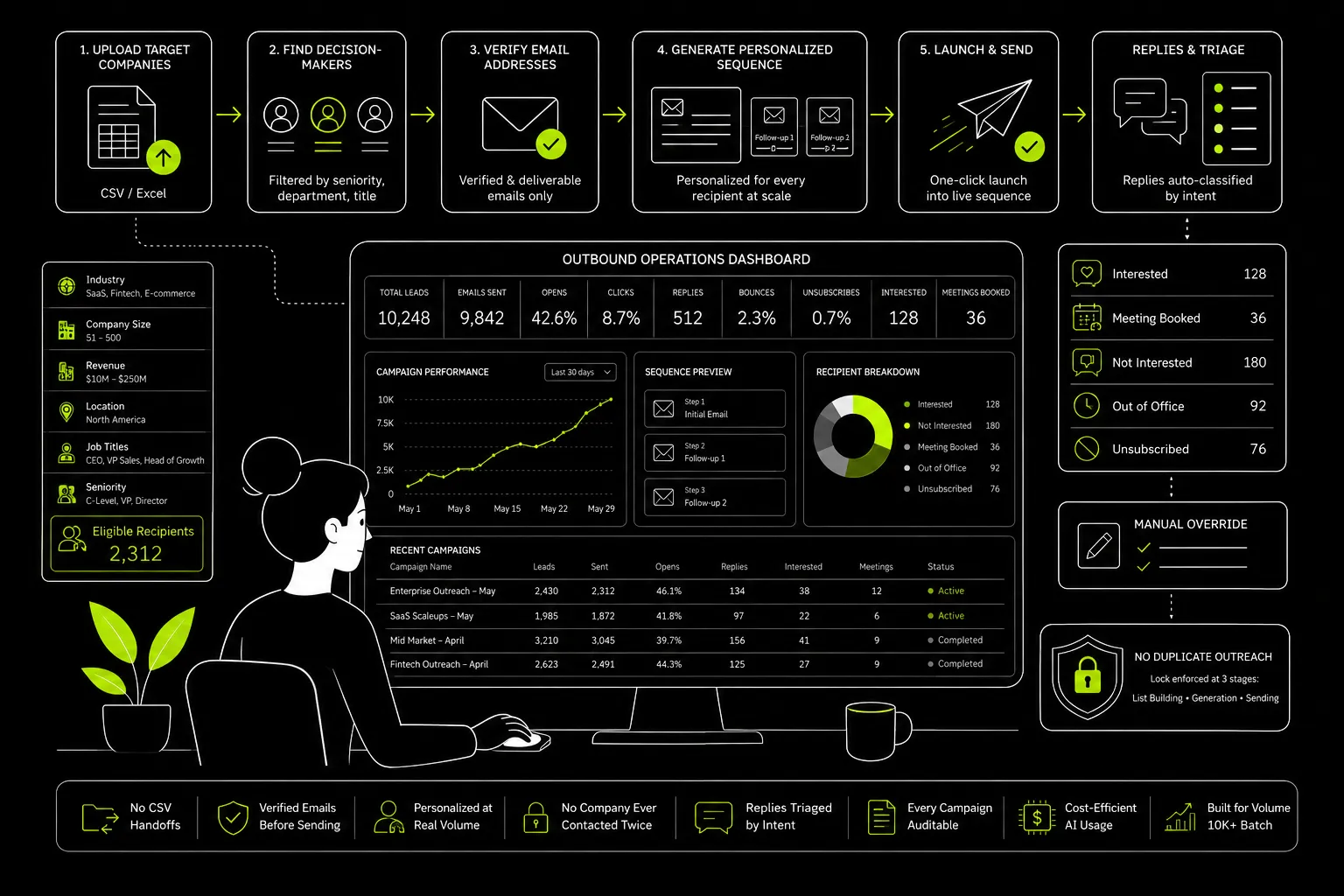
Outbound usually means a chain of disconnected tools: a list somewhere, an enrichment tool somewhere else, a spreadsheet of AI-written emails, a sending platform, and an inbox nobody has time to read. Every handoff is a CSV export and a chance to email the wrong person twice. Atlas collapses that chain into one dashboard. Upload a list of target companies and it finds the decision-makers, verifies their email addresses, writes a personalized sequence for each one, pushes it live, and then reads every reply and sorts it by intent, so the team only ever looks at the conversations that are worth their time.
The outbound process worked, but it lived across five places and one very brave spreadsheet. Target companies sat in one list, the tool that found contacts at those companies exported to another, email verification happened somewhere else, the AI-written copy was pasted into a sheet, and the sending platform had its own separate view of reality. Nobody could answer basic questions with confidence: how many verified contacts do we actually have, which companies have already been approached, what did we say to them, and who replied with real interest? The last question was the most expensive one: replies arrived mixed together, so genuine buying signals sat in the same pile as out-of-office bounces and unsubscribes, and got read days late. And because no single system knew the full picture, the same company could be approached twice by two different campaigns.
Upload a list, get real contacts. Atlas takes a list of target companies and finds the relevant people inside them (filtered by seniority, department and job title), then finds and verifies their email addresses, so campaigns go out to addresses that actually exist instead of quietly bouncing.
Personalization at real volume. Instead of one generic template, Atlas generates a tailored opening email and two follow-ups for every single recipient, drawing on what it knows about their company: industry, size, revenue band, website traffic, platform, location. Batches of up to ten thousand recipients are generated from one setup screen.
Nothing goes out unreviewed. Every batch records the exact filters and the exact instructions used to create it, so any campaign can be traced back to how it was built. The generated emails are readable in the dashboard before they are pushed live.
One-click launch. Approved batches are pushed straight into the live sending sequence and the campaign is activated from the same screen: no exports, no re-uploading, no manual field mapping.
A guardrail that cannot be bypassed. Once a company has been contacted, it is locked out of every future sending path: at list-building time, at generation time, and again at the moment of sending. The same company physically cannot be approached twice, even by a different campaign built weeks later.
Replies read themselves. Incoming responses are pulled back in and sorted by intent (interested, not interested, meeting booked, out of office, unsubscribe), with a filtered view per category and a one-click manual override whenever a human disagrees with the call.
Live performance in one strip. Total leads, emails sent, opens, clicks, replies, bounces, unsubscribes, interested contacts and meetings booked, all visible at a glance without opening the sending platform.
In practice the team works in one screen and one direction. A list comes in; Atlas fills in the people behind those companies and confirms their emails are real. The operator opens the generation screen, narrows the audience with a few filters, watches the eligible count update live, writes the four instructions that shape the sequence, and starts the batch. Progress is visible as it runs. When it finishes, the generated emails can be read, then pushed live and activated in a single action, and every company in that batch is immediately marked as contacted, permanently removing them from future sends. From then on the work is reading replies that have already been sorted: the interested ones sit in their own view, meetings booked in another, and the noise filtered out of the way. What used to be a week of coordination between tools became a session in one dashboard.
We'll map exactly what to automate first: no pitch, no commitment.
