Organic content builds authority, but it builds it slowly; there is no way to create demand on a Tuesday because the quarter needs it. Paid advertising is the fast lane, and it was closed, because producing an ad meant weeks of agency time and thousands of rupees for a single creative that may or may not work. Kinetix removes that bottleneck entirely. Ads, script, voice, image and video, are generated from a brief in minutes, launched as a set of competing variations, measured live, and then funded according to results, with spend moving automatically toward whatever is winning. Paid ads, organic social and cold outreach all run from the same platform, off the same brand and business context.
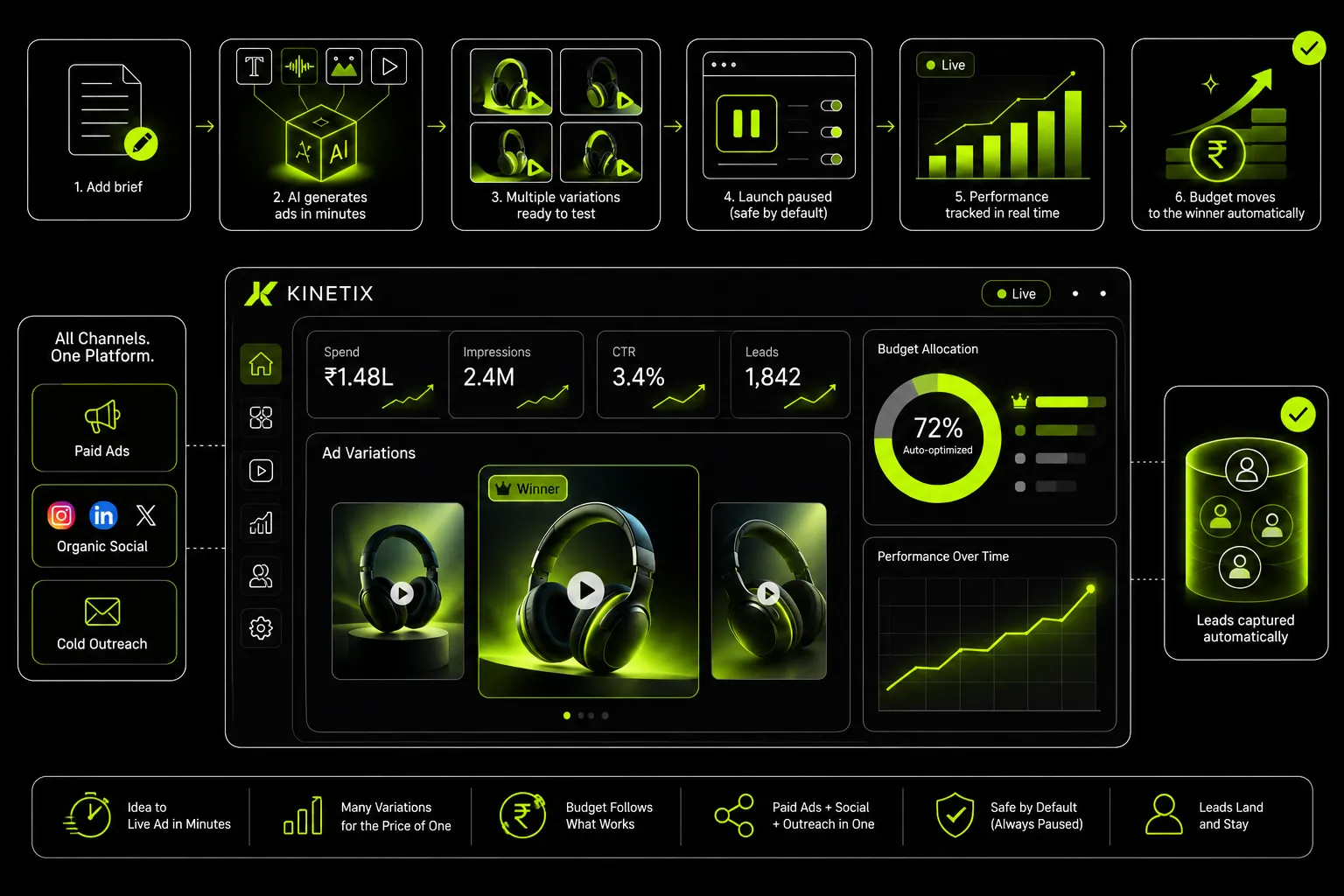
The organic side of the business was working: content and social were publishing consistently and steadily building authority and traffic. But it was all slow lane. Growth was capped at whatever pace organic content allowed, with no way to accelerate on demand when a launch, a season or a slow month called for it. The obvious answer was paid advertising, and the obvious answer was blocked by production: every ad needed a script, a voiceover, footage, editing and copy, which meant weeks of turnaround and thousands per creative through an agency. At that cost, a business gets one expensive guess instead of ten cheap experiments, and finds out whether the guess worked from a report that arrives a month later, by which time the budget is already spent. Meanwhile the paid side, the organic side and the outreach side each lived with different tools and different vendors, none of them working off the same picture of the business.
AI replaces the entire production pipeline. A complete ad, script, voiceover, imagery and video, is generated from a brief in minutes. No shoots, no editors, no copywriters, no scheduling around anyone's calendar. The gap between having an idea and having a live ad simply closes.
Every ad is grounded in the business, not in generic templates. The platform holds the brand's own positioning, offers and product context, and every generated ad is built from it, so output sounds like the business rather than like software.
Set the budget once. The system handles how that budget is distributed across the competing ad variations, instead of requiring someone to nurse allocations manually.
Competitive testing from day one. Rather than launching one creative and hoping, the system runs several against each other immediately and identifies the genuine performer using live data.
Budget follows the winner automatically. As results come in, spend is reallocated toward the ad that is actually driving traffic and sales, so money stops funding losers within the same campaign cycle, not after the next monthly review.
Live performance, never stale. Spend, click-through rate and budget consumption are pulled from the ad platform in real time on every view, so the answer to 'what is this costing us and what is it returning' is always current.
Nothing goes live by accident. New campaigns, ad sets and ads are always created paused; activating them is a separate, deliberate action.
Leads land and stay. Enquiries captured by ad forms flow into the platform automatically and are never dropped or overwritten, so paid traffic turns into a contactable list rather than a number on a chart.
One engine, not three vendors. Paid ads, organic social scheduling and analytics, and cold email outreach all run inside the same platform, off the same business data, so nothing falls through the cracks between tools.
Day to day it takes very little operating. Someone describes the offer or the angle they want to try, and within minutes there is a set of finished ads, voiced, cut, written, ready to review. A budget is set once. The variations launch together and start competing, and the dashboard shows spend, clicks and budget usage as they happen rather than as a summary later. From there the system does the part people are worst at: killing its own darlings, moving money away from the creative that isn't landing and toward the one that is. The recommended human involvement is light: one person keeping a general eye on campaigns and analytics, not a full-time operator. It is automated, but it was never designed to be a black box.
We'll map exactly what to automate first: no pitch, no commitment.
