In pharma distribution, the work that decides the month is follow-up work: asking a supplier whether a fast-moving product is available and at what price, asking a field salesperson what customers are actually demanding, asking a customer why they have gone quiet. It is simple work that never gets done consistently, because it depends on someone remembering. This system does the remembering. One business WhatsApp number reaches out on a schedule and on triggers from live stock data, and every reply that comes back is sorted and delivered to exactly the right person, procurement, sales, director or owner, inside one shared dashboard where nobody sees anyone else's conversations.
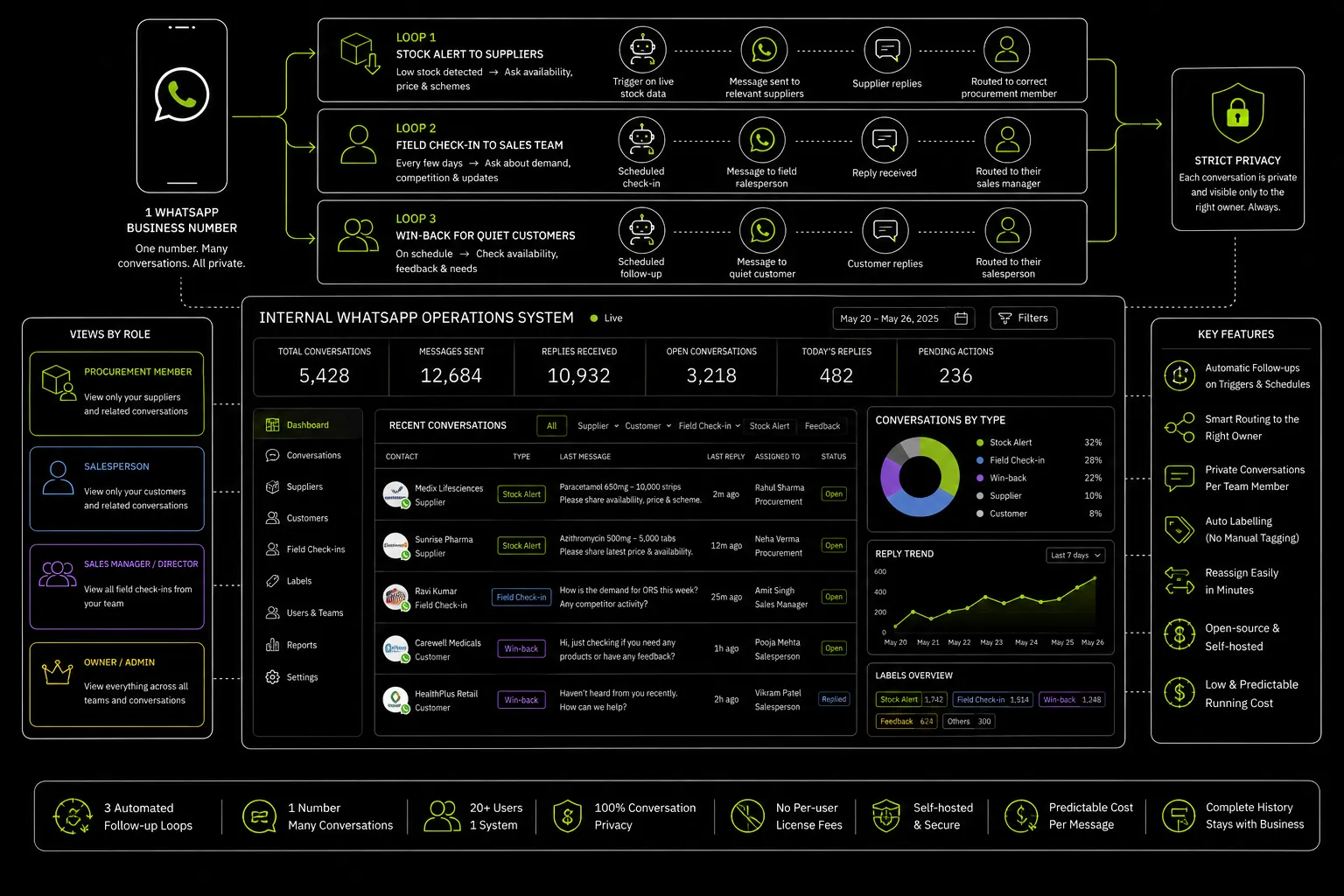
Three critical loops were all running on human memory. Procurement only discovered a product was short when someone happened to notice, then messaged suppliers one by one from a personal phone to ask about availability, price and current schemes. The director had fifteen salespeople in the field and no reliable way to hear what was happening, so field intelligence arrived late, in fragments, or not at all, after repeated chasing. And customers whose orders had quietly slowed down went weeks without contact, because no one owned the job of noticing. Everything happened on individual phones, which meant no history, no oversight, and no way for the business to see its own conversations. When a team member left, their entire relationship record left with them.
One business WhatsApp number replaced dozens of personal phones, for suppliers, customers and the field team alike. Every thread stays separate and private, the way email works: one address, many conversations, no crossover.
Three follow-up loops now run on their own. Stock levels are checked continuously and the moment a product falls to or below its minimum, the supplier who carries it is messaged automatically with the details needed to quote back, including products that have been sitting below minimum without being chased. Salespeople receive a field check-in every few days, targeted at accounts that are underperforming or haven't been visited. Customers who have gone quiet get a light-touch availability and feedback message on a set rhythm.
Replies route themselves to the right owner. Each supplier belongs to a procurement member, each customer to a salesperson. When a reply lands, it appears only for that owner, enforced by the system, not by a filter someone can switch off. Unrecognised numbers go to the owner for review.
One dashboard, a different view for every role. A procurement member sees their own suppliers. A salesperson sees their own customers. The director sees all field check-ins together, and can filter to today's replies or open threads. The owner sees everything across every team, filterable by team, label, date, person or status.
Conversations are labelled automatically (supplier, customer, field check-in, stock alert, feedback), so the dashboard stays organised without anyone tagging anything by hand.
Built on open-source, self-hosted foundations. There are no per-seat licence fees as the team grows, the conversation history belongs to the business, and the running cost is small and fully predictable: modest server hosting plus a known per-message fee, so the monthly figure can be calculated before a campaign is ever sent.
Day to day, nobody has to operate it. Stock dips below its threshold and the supplier is already being asked about availability and price before procurement has opened the dashboard. Field check-ins go out on their own cadence, and the director simply reads the answers side by side instead of chasing fifteen people for them. Quiet customers hear from the business on a rhythm someone would otherwise have had to maintain manually. Each person opens the dashboard, sees their own list with the new replies marked, and answers directly: no forwarding, no screenshots, no group chats, no asking who is handling what. The team stopped doing the routing and went back to doing the negotiating and the selling.
We'll map exactly what to automate first: no pitch, no commitment.
